
Articles
October 21, 2026
Most—Not All—Treasury Teams Stick With Diverse-Owned Firms

# Capital Markets
# Banking
# DEI
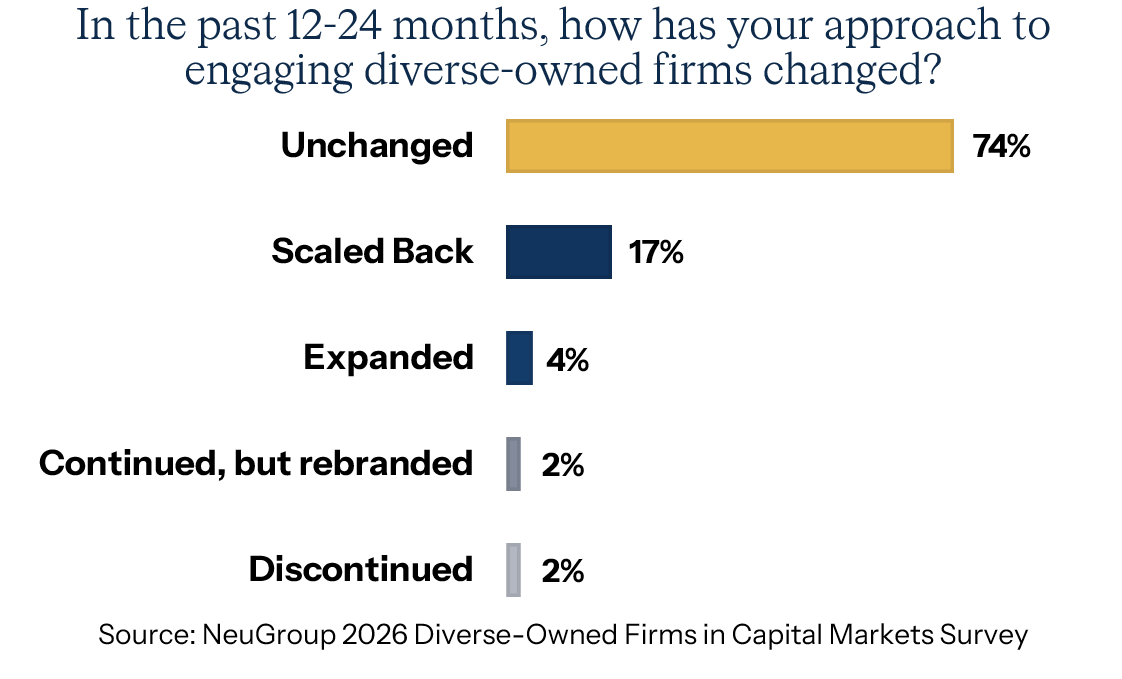
NeuGroup capital markets survey shows three-quarters of respondents didn’t change their approach while 17% scaled back.
The vast majority of treasury teams surveyed by NeuGroup have maintained their level of engagement with diverse-owned firms in capital markets transactions over the past couple of years (74%). Looking ahead, 89% plan in the next year or two to maintain or increase activity with financial institutions that include Black-owned, Hispanic-owned, women-owned and veteran-owned firms.
- However, 17% of respondents said they scaled back on their use of the firms in the past 12 to 24 months for reasons that include a change in one company’s stance on diversity programs; another said they received less value than expected. The number may also reflect reduced capital markets activity by some companies.
- Those are among the takeaways from NeuGroup’s 2026 Diverse-Owned Firms in Capital Markets Survey conducted in collaboration with Fitch Group (see chart below).
Perspective on the numbers. At a recent session of NeuGroup for Diversity, Equity and Inclusion , Sobani Warner , co-president of Siebert Williams Shank & Co. , welcomed the findings about retention and future use. “I'm thrilled to see that only 17% pulled back over the last 12 to 24 months,” she said. “That's what we've been seeing with our clients. If you're building a long-term relationship with a service provider, you don't necessarily make a U-turn on a short-term change.”
- Annie Seelaus , CEO of broker dealer and asset manager R. Seelaus & Co. agreed with Ms. Warner and offered some insight on why some corporates have given less business to diverse-owned firms. “Where we saw the most candor from people who pulled back were people whose business was directly tied to something with the administration and fear that that potentially would become a lightning rod,” she said.
- Ms. Seelaus also expressed concern that less established firms may be more affected by companies reconsidering their approach in the current political climate. “I worry that some of the smaller, diverse firms who have been around for a shorter amount of time were disproportionately affected by that. I suspect that some people who have scaled back are potentially using fewer firms or not taking meetings with newer firms.”
Share of wallet and other inhibitors. One corporate capital markets executive said when a company issues bonds frequently, it has enough underwriting business to satisfy its major lending banks while giving diverse-owned firms co-manager roles. But when issuance slows, the calculation changes. “If you go two, three years without a bond offering and activities are smaller, that's when your banks are going to start putting on the pressure,” he said.
- "And then unfortunately, this will be the first place that is going to have to get scaled back because you need to then reward the banks that are putting up the capital,” he added, noting that the effect would likely be concentrated in bond underwriting co-manager assignments, rather than necessarily extending to services such as share repurchases.
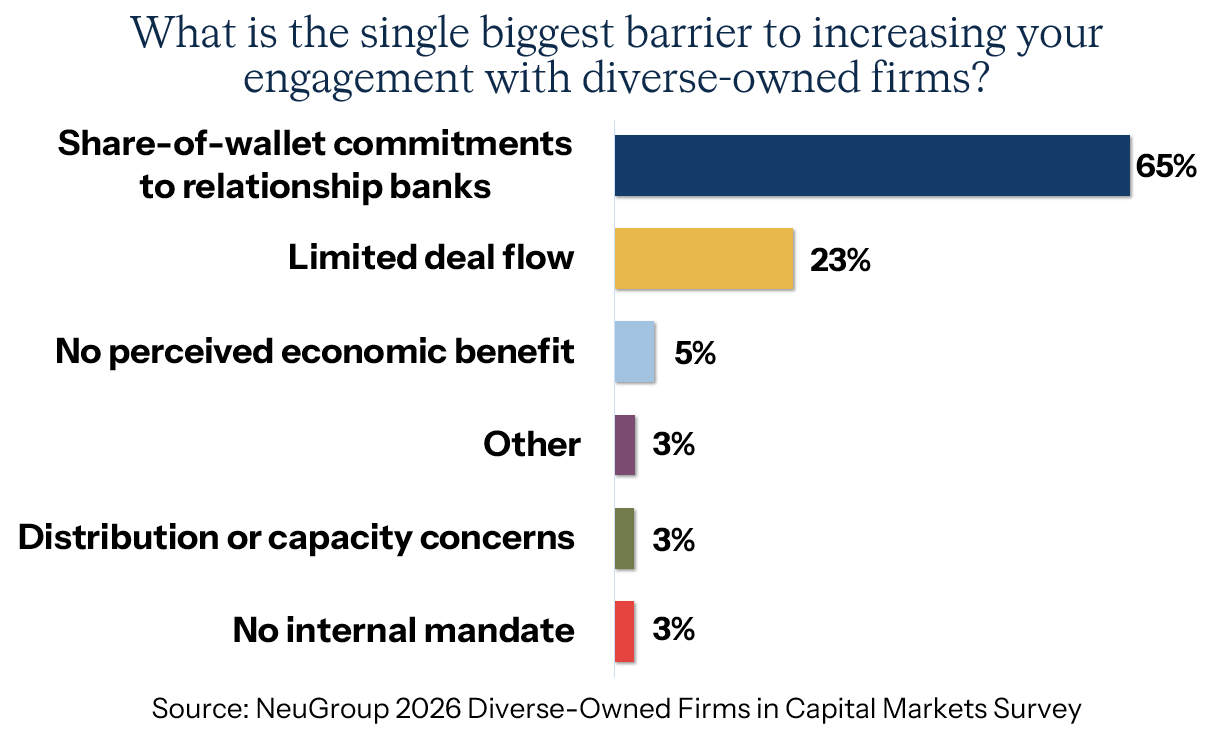
- Indeed, as the chart below shows, share of wallet commitments to banks in a corporate’s revolving credit facility are the top obstacle for treasury teams (chosen by 65% of respondents) to increase the business they allocate to diverse-owned firms. Limited deal flow, at 23%, is the only other reason chosen with more than 5% of responses.
The value of diverse-owned firms. For the third year running, corporates ranked diversification of the investor base as the No. 1 benefit (63%) of working with diverse-owned firms, with supporting company diversity objectives placing second (55%) and unique market insight coming in third (45%). And while getting better execution and economics ranked just sixth (13%), several members attending the NeuGroup session made clear that is where they find the most value.
- “We think of it more from a perspective of actually providing economic value, less from kind of an internal diversity mandate perspective,” one said. “We definitely expect to continue partnering with the D&I firms going forward because we do think that they provide real value for us.”
- Another participant got specific. “Where I find the value is the greatest is on activities like commercial paper and share repurchase, where I think when you look at the big banks or credit facility banks, that's not their focal point. You're not getting the same level of attention, insights, frankly, quality as some of the diverse-owned firms where that's a larger piece of the business.”
- And quality of work, some participants said, is what makes relationships between corporates and diverse-owned firms truly durable, no matter the political environment.
- “It's a value add proposition more than it is a DEI initiative on the way that we connect as a service provider,” Ms. Seelaus said. “So I think that longstanding clients who have worked with us and other firms in the space felt they really didn't need to make a move.”
Dive in
Related
Insights
Evolving the Capital Markets Supplier Mix with Diverse-owned Firms
By Joseph Bertran • Oct 9th, 2025 • Views 54
Insights
Evolving the Capital Markets Supplier Mix with Diverse-owned Firms
By Joseph Bertran • Oct 9th, 2025 • Views 54