
Articles
November 18, 2026
NeuGroup’s Working Capital Awards: Treasury Leads A Cash Push

# Cash and Working Capital
# People and Talent
# AI
Four winning programs made cash a responsibility shared across functions, standardizing payment terms, speeding cash to small suppliers and using AI to increase cash visibility.
Four very different working capital programs earned recognition in NeuGroup’s inaugural Working Capital Innovation Awards , sponsored by SAP Taulia . Bristol Myers Squibb built a cross-functional office that makes cash a companywide responsibility, and IBM rebuilt treasury around an AI-enabled platform that tracks receivables, payables and inventory in near-real time. Colgate-Palmolive enforced 90-day supplier terms alongside procurement, while Alibaba/Freshippo funds small suppliers as soon as goods reach its warehouse. In each, treasury led work that reached into procurement, operations or the supply base.
A jury of five senior treasury and finance leaders scored nominations blind and chose one winner in each of four categories. It weighed value creation and cross-functional collaboration most heavily.

Bristol Myers Squibb made cash every function’s job
Office of Working Capital Management
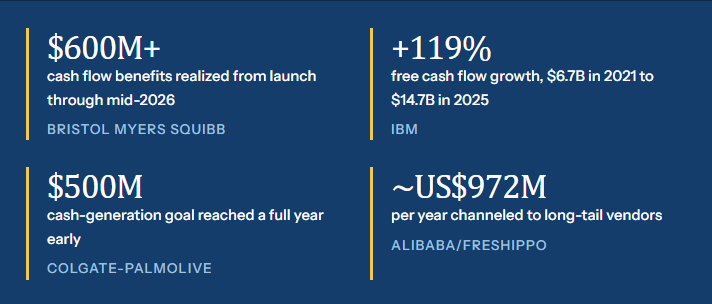
BMS formally established its Cash Leadership Office in January 2023, with the CFO as executive sponsor. “Treasury can’t drive this alone. We don’t own payables, we don’t own procurement, we don’t own any of these functions,” said Sandra Ramos-Alves , SVP and treasurer. Each lever (procure-to-pay, order-to-cash, commercial and inventory) has a named owner outside treasury. On payables, tighter processes stopped the company from paying ahead of terms, and procurement added term standardization, supply chain finance and virtual cards. For more on Sandra’s approach to treasury management, in addition to reading the full report , you can listen to our conversation with her on the Strategic Finance Lab podcast.
IBM rebuilt treasury on a single data model
Technology Transformation
In under three years, IBM treasury replaced spreadsheets and a bespoke TMS with FiTTER, an AI-enabled platform built on a single data model that unifies cash, procurement, sales and supply chain data—cutting the overall application count from 101 to 36. Team members query it in natural language, which lets treasury manage receivables, payables and inventory as they happen; under the old systems, working capital was reported after the fact. The platform helped drive one of the largest free cash flow improvements among the nominees. Kevin Wilkins , an IBM executive of digital transformation and technology, said their technology and working capital practices changed “at the same time as the culture, which is probably the hardest of those three.”
Colgate-Palmolive’s procurement team became the program’s champion
Procurement and Treasury Partnership
Colgate had been paying suppliers in 67 days while competitors took well over 100. The CFO and chief procurement officer co-sponsored a push to enforce the company’s 90-day policy. They set shared KPIs, coded exception approvals into the ERP and allowed no concessions on other terms. The effort reached its three-year, $500 million cash generation goal a year early. “The reason why it worked was that it was not just a treasury initiative, but a joint one,” said Anton Kolev , senior director, global treasury.
Freshippo funds its smallest suppliers within days
Supply Chain Resilience and the Long Tail
Alibaba’s grocery retailer runs two programs side by side to pay small fresh-produce vendors early. One is a self-funded early-payment program, and the other is reverse factoring that Freshippo underwrites with its own supplier performance data. Both programs exist for the same reason: if those suppliers fail, Freshippo’s supply chain fails with them. Vendors can draw funds once goods reach the warehouse, before an invoice exists. Pricing is set by the length and depth of the relationship, with no penalty for size. Fiona Li, a member of Freshippo’s treasury team, said they built the program together “so that any supplier, regardless of size, can access liquidity at a fair price with speed.”
Access the full report on NeuGroup Connect to read each winner’s full profile, including its advice for peers on where to start and the jury’s scoring rubric.
Dive in
Related
Insights
Nominations Open for NeuGroup’s 2026 Working Capital Innovation Awards
Aug 20th, 2026 • Views 81
Insights
Working Capital Innovation Awards: Meet the 2026 Winners
By Joseph Bertran • Nov 18th, 2026 • Views 37
Insights
Meet the Judges for NeuGroup’s 2026 Working Capital Innovation Awards
Sep 22nd, 2026 • Views 86
Insights
Nominations Open for NeuGroup’s 2026 Working Capital Innovation Awards
Aug 20th, 2026 • Views 81
Insights
Meet the Judges for NeuGroup’s 2026 Working Capital Innovation Awards
Sep 22nd, 2026 • Views 86
Insights
Working Capital Innovation Awards: Meet the 2026 Winners
By Joseph Bertran • Nov 18th, 2026 • Views 37