
Articles
April 30, 2025
M&A Playbooks Are Showing Up on More Treasury Team To-Do Lists

# M&A
# Capital Structure
Playbooks provide options for financing as well as post-deal checklists for integration of the acquired treasury team.
Volatile markets and elevated uncertainty have taken a toll on U.S. M&A volume this year. But treasurers are not sitting on their hands waiting for a pickup in deal activity. They’re preparing now for future transactions, some by working on M&A playbooks for acquisition finance as well as the integration of two treasury teams striving to operate as one.
- That takeaway emerged at the NeuGroup for Capital Markets first-half meeting sponsored by Loop Capital where members from several companies mentioned M&A playbooks when sharing their projects and priorities.
- The goal, one director of capital markets said, is “getting ahead of anything down the pipeline,” adding that “in the event that a large M&A transaction arises, we will be prepared with a plan to make implementation more efficient.” Another member said treasury needs a playbook to replace an approach that has been “event driven.”
Context, content, pages. In a follow-up email, one member explained “M&A has not been a focus of the firm for several years as we concentrated on our core business and management changes.” With those changes completed, the company could become more active in M&A, he said, explaining why the playbook is a current priority.
- With the caveat that “we’re still early on in our scoping of the M&A playbook,” this member envisions a document between 15 and 20 pages that “will concentrate on funding options between cash, debt and equity, depending on deal size and other factors.”
- “It will also include an operational component for treasury diligence and integration” as well as treasury “touchpoints” with other functions. Treasury will turn to the playbook after the treasurer is made aware of a deal, he said.
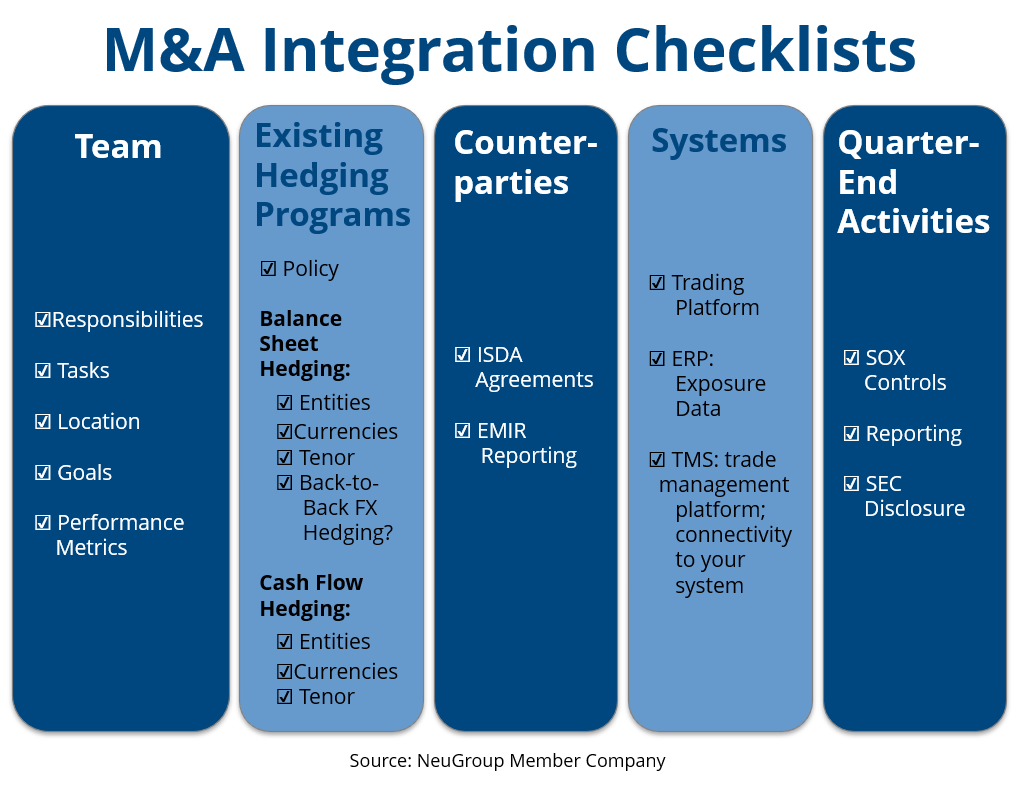
An integration checklist. For another member, the financing portion of the M&A playbook will come from bank documents that “are more useful when it comes to the transaction itself, like funding decisions, capital structure, etc.,” they wrote. Their focus is on integration and they provided the checklists below of items to review at an acquired company as the process begins. The first question, the member said, is whether the acquired company is on the same fiscal calendar.
Dive in
Related
Insights
Real-World Use Cases Reveal How Treasury & Finance Teams Are Putting AI to Work
Sep 14th, 2026 • Views 11
Insights
Real-World Use Cases Reveal How Treasury & Finance Teams Are Putting AI to Work
Sep 14th, 2026 • Views 11