
Articles
December 10, 2025
AI Stepping Stones: How to Move From Insight to Action Safely

# AI
# Technology
# Key Takeaways
Takeaways from an AFP 2025 panel featuring Joseph Neu and treasury leaders from two mega-cap corporates.
A successful treasury AI journey must include building trustworthy data layers, using analytics and AI to identify risk and opportunity faster, and preparing to use AI agents under strong control frameworks.
- That insight and others emerged from a session titled Next-Gen Treasury Dashboards: Harnessing AI & ML to Analyze Data, Improve Decision-Making, and Make Automation Smarter moderated by NeuGroup founder and CEO Joseph Neu at AFP 2025 in Boston, featuring treasury leaders from two companies whose treasurers are members of NeuGroup for Mega-Cap Treasurers .
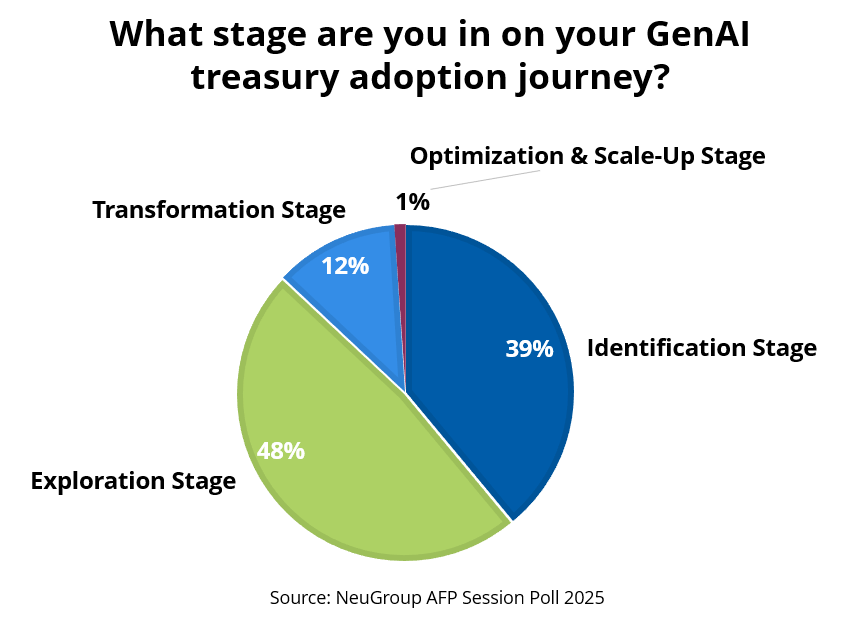
The discussion underscored that most organizations are still early in the journey. An in-session poll showed that most treasury teams remain in the identification or exploration stage for generative AI (see below). The results closely mirrored findings from a NeuGroup member survey published in a recent report by Citi Advisory Group: GenAI in Treasury: A Practitioner’s Guide .
While the conversation in Boston ranged from dashboards to GenAI, it repeatedly returned to a practical reality: treasury teams don’t need perfect enterprise architecture to begin. They need governed data, confidence in outputs and a path from insight to action.
Dashboards first: the adoption bridge. Early wins often come from better treasury dashboards. “Dashboards are a good way to frame AI use cases in treasury and the broader finance organization,” Mr. Neu said. “First, they channel data into a visual format to help inform people with the information that they need to do their job.”
- He added, “This same data in theory is what will inform AI models, train them in how to support humans doing treasury activities but also to help them learn how to do the job better.
- “As the AIs learn and evolve agentic capabilities, they will quickly bring on subsequent stages where AI will do more and more of the work. This starts with building and modifying the treasury dashboard.”“As the AIs learn and evolve agentic capabilities, they will quickly bring on subsequent stages where AI will do more and more of the work. This starts with building and modifying the treasury dashboard.”
A solution for cash challenges. For one panelist, AI-enabled dashboards help address the challenge of pinpointing, mobilizing and deploying cash dispersed across entities and geographies. “There can be $2 billion somewhere, but it’s everywhere, it’s across the globe,” they said. “Our dashboard shows us very clearly where the money is and what currency it’s in and when it’s going to be freed up.”
- The dashboard’s visualizations are paired with AI- and analytics-enabled capabilities like flagging trapped or excess cash; and the tool can improve over time by learning from forecast-to-actual variances. “It transforms the way we make decisions,” they said. “It speeds the decision and it gives me the confidence of what I’ve got correct.”
Trust and double-checking.” That confidence is critical. As tools improve, organizations often struggle to trust outputs—especially when treasury teams are conditioned to validate everything through Excel. A panelist described a common AI adoption barrier: team members see AI model outputs and immediately attempt to disprove them by pulling data into legacy spreadsheets and cross-checking across systems.
- “Invariably, you’ll get a team member who says, ‘I’m not too sure we can trust that number.’ And ‘I need you to put this data into my Excel spreadsheet to validate it.’”
- Over time, they said, the pattern became clear: the machine was usually right, and the instinct to re-check slowed decision-making. “I think 9.9 times out of 10, we were wrong. The machine was right in the first place.”Over time, they said, the pattern became clear: the machine was usually right, and the instinct to re-check slowed decision-making. “I think 9.9 times out of 10, we were wrong. The machine was right in the first place.”
- The discussion touched on what more treasurers are starting to confront: if insights are proven reliable, the next stage is execution—where AI agents could initiate actions such as payments, subject to approvals, limits and oversight.
- “One of the use cases I think about is asking the tool to go and make a payment,” one panelist said. “The technology is already there—SWIFT, the bank platforms we’ve trusted for decades—so once you trigger the transaction, it can flow through, reconcile in SAP, and post.”“One of the use cases I think about is asking the tool to go and make a payment,” one panelist said. “The technology is already there—SWIFT, the bank platforms we’ve trusted for decades—so once you trigger the transaction, it can flow through, reconcile in SAP, and post.”
Progression and people. Panelists agreed that treasury should not chase AI for its own sake, but build toward it in the right, progressive order: governed data, dashboards that accelerate liquidity decisions, and a controlled expansion into GenAI and agents. Just as important, the panel stressed that the human element remains non-negotiable as AI moves closer to execution.
- Mr. Neu observed, “Whatever you use in this technology has to be augmented with human capital, because at the end of the day we’re talking about money—and you’re not going to get that back once it goes.”
- As capabilities evolve, one panelist said, treasury responsibility remains constant: “It isn’t letting it run free with nobody looking over it.”
Dive in