
Articles
February 4, 2026
How BMS Is Embedding Cash Accountability Across the Enterprise

# Cash and Working Capital
A cash leadership office is aligning procurement, finance and commercial teams around cash flow.
Until 2023, procurement, commercial and operational teams at Bristol Myers Squibb made decisions affecting cash flow without any unified view of the impact on the larger enterprise. Cash flow optimization was treasury’s domain. To change this dynamic and improve working capital management, the company built a cross-functional cash leadership office to push accountability into the business—with treasury playing a key role in shaping BMS’s cash culture.
- BMS treasurer Sandra Ramos Alves and global working capital lead John-Robert Maguire shared the experience with NeuGroup members at meetings of NeuGroup for Life Sciences Treasurers and NeuGroup for Working Capital Optimization. The company, working with EY as a consulting partner, freed up hundreds of millions of dollars in cash by tightening payment practices, extending supplier terms and closing gaps between contracted terms and what was actually being paid.
- “We’re on a long, difficult journey. You have to be really patient and persevere,” Ms. Ramos Alves said. “People from other companies will ask me ‘Why are you doing this to yourself?’ and I say because it’s important.”

Sandra Ramos Alves, Treasurer, BMS
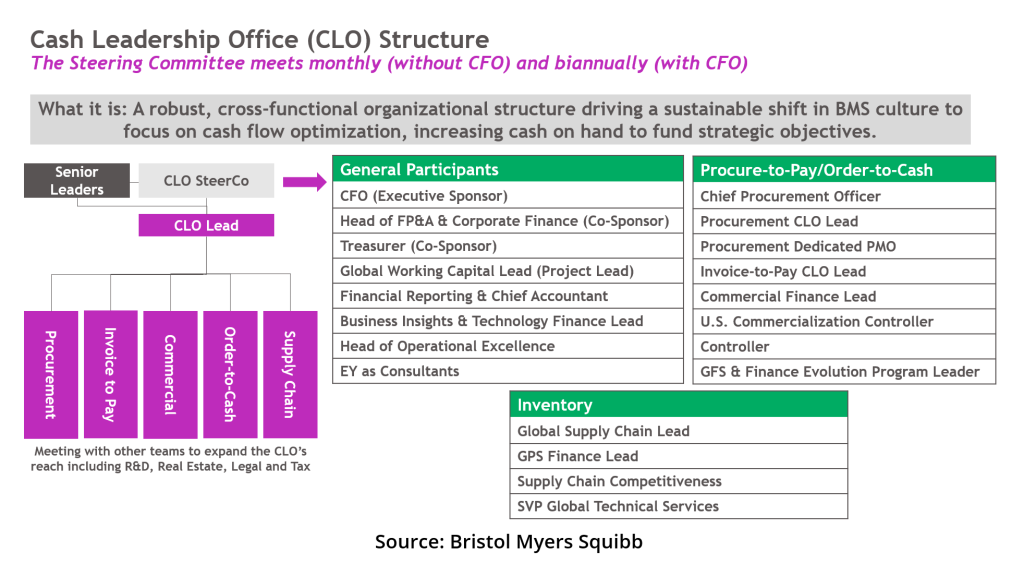
How a cash leadership office is structured. The cash leadership office took shape as a cross-functional governance model, with leaders from procurement, finance, commercial, invoice-to-pay and supply chain meeting regularly to review working capital performance and agree on next steps (see chart). Treasury helped coordinate the effort, but accountability now sits with the teams managing supplier terms, payment execution and operational follow-through. “Treasury can’t own this program,” Mr. Maguire said. “You really need it to be owned by the teams in the various areas.”
- Discussions focused on practical operating practices, with teams expected to explain the implications of their choices. The forum helps to shift conversations away from siloed P&L optimization toward enterprise-level trade-offs.
- The cash leadership office defined when deviations from agreed payment terms, recurring early-payment requests or gaps between contracted and actual payment behavior would be escalated. Working capital performance is tracked using consistent measures of receivables, payables and inventory and benchmarked against peers before being reviewed with senior leadership.
- Ms. Ramos Alves noted that visibility itself became a catalyst. In one instance, simply showing how many vendors were already on extended terms created momentum that formal policy alone had not achieved.
A marathon, not a sprint. From the outset, BMS leaders framed the cash leadership office as a long-term operating shift rather than a short-term optimization exercise. Aligning cash priorities across procurement, commercial and finance required time, repetition and visible reinforcement from leadership. “This is not something that’s going to be quick,” Mr. Maguire said. “While you might have some early wins, it’s an ongoing process that needs to have top-down endorsement and consistent, long-term effort.”
- Early momentum improved once expectations around cash were clearly set by senior leadership, including the CFO, and ownership was pushed into the business. Leaders are now expected to explain decisions and what changes they propose when gaps in execution surface.
- Mr. Maguire said progress accelerated once teams shared a common understanding of how day-to-day processes affected cash. “What started to drive breakthroughs was education,” he said. Ms. Ramos Alves described the effort as a sequence of “baby steps,” with changes accumulating as cash considerations became a more routine part of decision-making.
The procure-to-pay proving ground. The cash leadership office focused first on procure-to-pay, seeing an opportunity to make the link between operational decisions and cash outcomes more visible. The goal: Building momentum through a series of practical adjustments that could demonstrate impact and encourage new behaviors.
- The initial emphasis was on foundational payment practices that had developed over time, including making payments daily, which was convenient in the short term but reduced cash flexibility.
- As those behaviors took hold over several years, procure-to-pay delivered the largest share of the cash freed up by the program. Much of that impact comes from extending supplier payment terms, tightening exceptions and closing gaps between what contracts allowed and what the company is actually paying, helping establish the credibility needed to expand the approach throughout the company.
- In an analysis of remaining opportunities, the office found that further improvements could extend how long BMS holds cash before paying suppliers by about 10 days on average, keeping millions of dollars available to the business for longer without changing underlying commercial agreements.
Building enterprise-wide discipline. The cash leadership office created a common approach to evaluating choices across finance, commercial and operations. Commercial leaders began to weigh in on customer terms and concessions, where choices made to support growth or speed could materially affect cash timing.
- Supply chain discussions focused on how inventory planning tied to launches and shifts in demand, including how much product to keep on hand and when to produce, could tie up cash for extended periods and influence working capital outcomes.
- Mr. Maguire said the company recently rolled out supply chain finance and a virtual card program, though neither was positioned as a primary driver of results. The tools were used selectively and positioned as complements to existing payment-term strategies, not as replacements.
- EY consultants supported BMS throughout the process, providing external perspective on cash governance, benchmarking and working capital measurement. Ms. Ramos Alves described EY as “a huge help in this space,” reflecting the value of having an outside reference point alongside internal decision-making.
- Benchmarking in peer settings like NeuGroup meetings provided other important yardsticks as the approach evolved. Comparing practices and outcomes with peers helped challenge internal assumptions and calibrate expectations. “Talking to others in similar companies is quite helpful: they have experience elsewhere, and they know what’s possible,” Ms. Ramos Alves said.
Dive in
Related
Article
The Downside of Precision, the Hulk Inside Life Sciences and Thinking Cash, Cash, Cash
Sep 24th, 2019 • Views 4
Article
The Downside of Precision, the Hulk Inside Life Sciences and Thinking Cash, Cash, Cash
Sep 24th, 2019 • Views 4