
Articles
April 9, 2025
Cash Forecasting: Automation Is Not Automatic

# Cash and Working Capital
# AI
NeuGroup’s 2025 Treasury Outlook Report reveals that most companies have not automated their cash forecasting processes.
Technology and automation may be taking center stage as more treasury teams embark on transformation initiatives, but NeuGroup’s 2025 Treasury Outlook Survey reveals that cash forecasting remains a manual process for a majority of companies.
- The survey published this week shows that more than half (55%) of respondents are not using any automation for cash flow forecasting (see chart).
- “Part of the reason is they don’t have access to technical expertise, or the capacity to implement the right solutions,” said Joseph Bertran, NeuGroup’s head of research. He noted that another chart in the survey shows only 26% of respondents have a dedicated treasury technology resource.
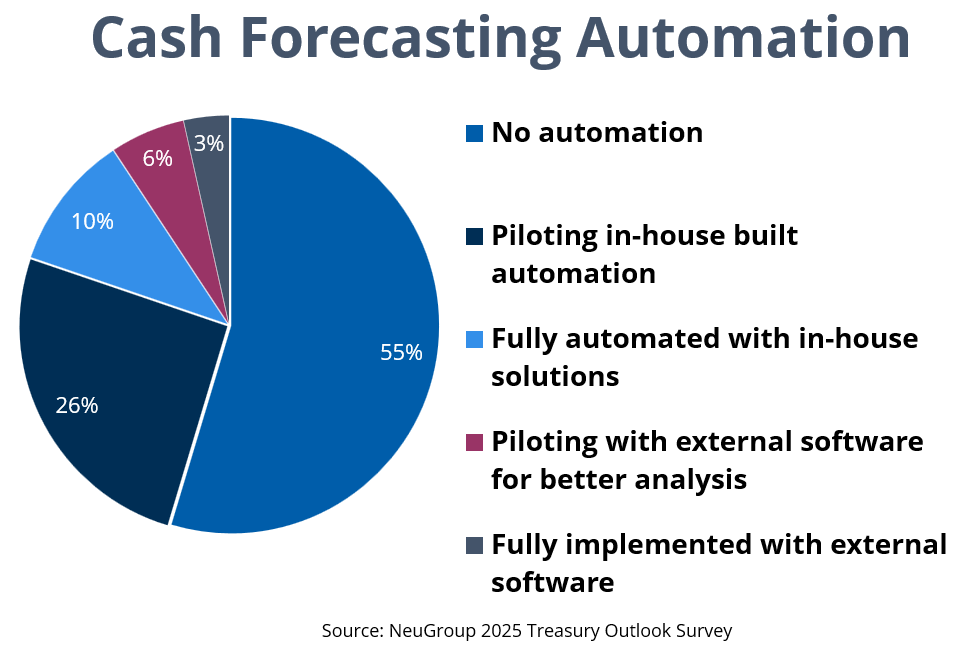
How companies are automating. The survey found that 26% of respondents are piloting in-house solutions, while just 10% have reached full automation with tools developed internally. Even fewer (9%) are experimenting with or fully implementing external forecasting software offered by TMS vendors and other fintechs.
- The spectrum of what companies are doing and not doing may also reflect a fragmented landscape of options with no single solution right for everyone or clearly better than the rest.
- “For the companies that have adopted a cash flow modeling platform, there was no one solution that seemed to be a leader in this space,” said one member quoted in a recent NeuGroup Talking Shop post. “Some were leveraging their TMS, some were using tools from banks and some were using dedicated platforms.”
Sticking with Excel. In In the meantime, many treasury teams—including most if not all of the respondents who said “no automation” in the 2025 survey—continue to use Excel-based forecasts, which offer more control than third-party tools at a cheaper price.
- The member quoted above did their own survey of peers last fall. “I was surprised to learn that many companies do still use Excel very successfully for their cash flow modeling. I estimated that it could be 50% or even more,” they said. “I think it’s because Excel is still a perfectly good tool to fall back on, and essentially free.”
Potential in AI—but it’s early days. Elsewhere in the survey, 33% of members shared that they are using artificial intelligence (AI) tools in some way, with another 38% planning to use or pilot AI in the next 12 months. Mr. Bertran said AI and machine learning (ML) may be used increasingly for cash forecasting as solutions including chatbots and ML models become more accessible.
- In a recent NeuGroup Insights video, Bechtel’s Dan Degagne discussed a machine learning cash forecasting pilot he spearheaded. Despite early skepticism about ML’s ability to predict the company’s “lumpy” cash flows, the results beat expectations.
- Other members report a more mixed bag with AI and ML-enhanced cash forecasting automation. “We have a machine learning tool built by a third party that can get pretty close on the revenue forecast, but it’s not very actionable,” a member said at last week’s meeting of NeuGroup for Life Sciences Treasurers in Chicago.
- She said the tool can be useful for planning, but because it doesn’t show its work and the forecast can’t be broken down in a more granular way, it’s not as useful as more purpose-built solutions, including the company’s Excel-based forecast.
Our forecast. About half of the attendees at the life sciences meeting listed improving forecasting as a priority. That’s just one reason we’re extremely confident in this forecast: improving cash forecasting will remain a perennial topic across the NeuGroup Network—with or without automation.
Dive in