
Articles
April 6, 2023
Volatile Rates Spark Corporate Interest in Pre-Issuance Hedging

# Capital Markets
# Risk Management
Multiple members have executed pre-issuance hedges in recent weeks, with many more strongly considering them.
Extreme volatility in interest rates is fueling strong interest in pre-issuance hedging among NeuGroup members who want to mitigate risk—especially those who plan to issue fixed-rate debt in 2023.
- At the first-half meeting of NeuGroup for Capital Markets sponsored by Chatham Financial and Loop Capital Markets, members and representatives from Chatham agreed that this is an opportune time for companies to consider pre-issuance hedging , particularly using forward-starting swaps.
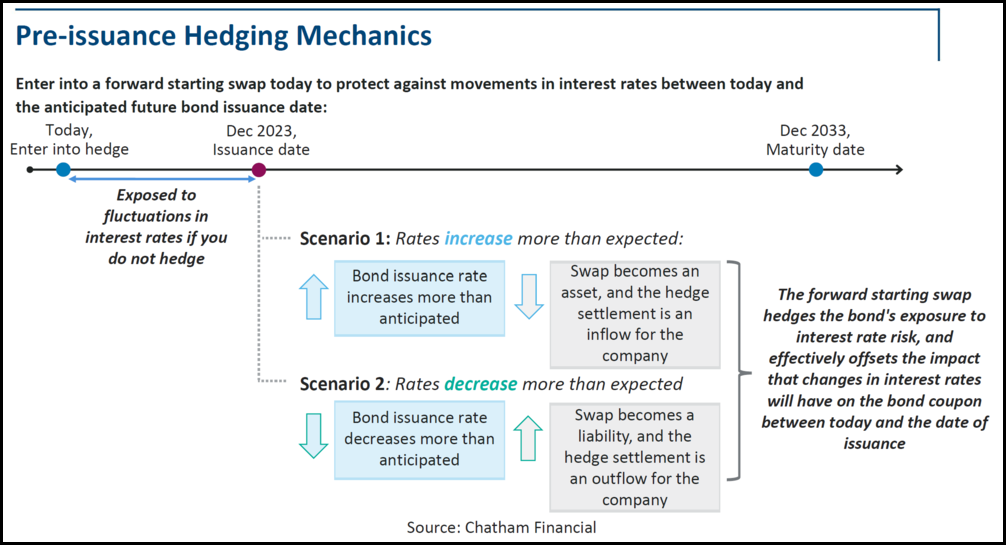
- Pre-issuance hedging mitigates interest rate risk for a company’s future bond issuance by offsetting changes in the Treasury component of the bond coupon that occur between the date of the hedge and the date of bond issuance, according to Chatham.
- “This strategy is particularly useful in volatile interest rate environments,” Chatham’s presentation said.
Volatility drives interest. “Interest rates have been significantly volatile as inflation has remained elevated, geopolitical tensions have run high, and recession fears have grown,” the presentation said. In the past year, for example, the 10-year US Treasury yield reached a low of 2.32% and a high of 4.25%.
- And in the immediate aftermath of the collapse of Silicon Valley Bank, the US 2-year Treasury yield had its largest three-day decline in 36 years following a rapid rise in 2022.
- “With all this volatility, we really want to lock in rates,” said one member who opportunistically entered into a forward-starting swap in mid-March.
Instrument options. Corporates primarily use treasury locks to hedge short-term risk when an issuance is expected in three to six months, and forward-starting swaps to hedge rate volatility for bond offerings that occur on a longer time horizon.
- One member said her company had only done pre-issuance hedging on a short-term basis, primarily using treasury locks. But she has shifted recently to forward-starting swaps on a longer-dated basis “based on financings we expect to be done, but don’t actually have details on.”
- “We know at some point we may want to be able to issue debt at attractive rates, but we’re not sure when,” another member said in agreement. “So if we have more of a window, a swap is a better instrument, even though treasury locks work better when we know when we’re going to go to market.”
- The Chatham chart below explains how a forward-starting swap works.
A sometimes scary strategy. Another member at a corporate that issues debt up to six times a year described the difficulty of managing interest-rate risk in the last 15 months. “With rates having gone up very quickly very fast, we’ve been pre-issuance hedging since January 2022 when rates started to take off,” he said. “It’s gotten scarier and scarier the longer we’ve been doing that, and the higher rates went.”
- The member is sticking with the strategy in part because of interest rate indicators his team built that analyze factors such as inflation and geopolitical tensions to help forecast rates. “Those indicators have been flashing bright red for about six months,” he said.
Picking your spots. In the last year, his team has focused primarily on two-year hedges, “because if rates plummet, you’re not going to get your face ripped off like if you did a five-year hedge,” he said.
- “Our auditor is okay with us having a lot of two-year hedges on the book, but then if we’re going to issue a three-year bond, we can just apply those two-year hedges to that bond,” he said.
- “So if you put on a lot of two-year, three-year, five-year, seven-year and 10-year swaps, all those different tenors, you can look at how the curve shifted up or down during the time from execution to unwind to see which ones you want to unwind,” he continued. “That can be a good tool that can help capitalize on interest rate volatility.”
Dive in