
Articles
January 21, 2026
Treasury Efficiency Rises With Revenue Across Company Sizes

Treasury teams at larger companies support significantly more revenue per person, suggesting that efficiency improves as companies scale.
Across companies of all sizes, treasury efficiency—as measured by revenue per employee—increases as the corporation’s top line grows. Proof of that pattern is underscored clearly in NeuGroup’s new 2025 Treasury Headcount Survey , reflecting the scale advantages treasury teams develop as organizations grow.
- The results align well with how treasurers think about scale. “Treasury work is inherently scalable,” one member said in response to the data. “Doing the same things but adding zeros to the amounts doesn’t usually require the team to grow at the same pace.”
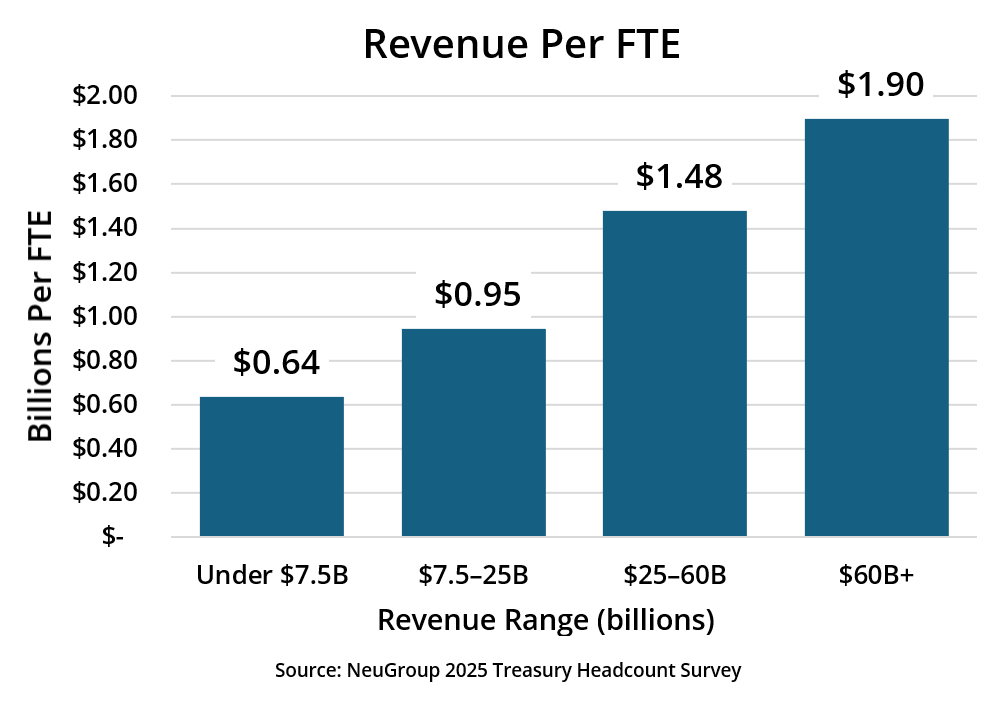
The power of scaling. Aggregated surveys of our groups for mega-cap, large-cap and mid-cap treasurers (see chart) show the highest efficiency in the group with the largest revenues ($60B+), where companies on average produce $1.9 billion in revenue per FTE.
- Data from just the large and mid-cap groups helps show in concrete terms the power of scaling—where headcount grows much slower than revenue. Treasury teams with annual revenues in the $10-25 billion range average 27 individual members. But the next revenue band ($25B to $100B+) has just 30 employees on average. In other words, only a few more treasury roles are supporting companies with as much as four times as much revenue.
- One member said that the data makes sense because some treasury processes are “super scalable (i.e., $1B of FX derivatives is generally no harder than $2B),” but clarified that other tasks add complexity will require more resources to do well.
- The results raise a question members are increasingly focused on: what helps teams move up the efficiency curve faster? Several treasurers said they are actively challenging their organizations to scale without adding headcount, leaning instead on new tools, systems and automation. And yes, that includes AI. One member noted that the goal is not simply to do more with the same team, but to rethink how work gets done, replacing manual processes with technology rather than staffing.
Context for complexity. The chart provides a clear view of how treasury efficiency changes as companies grow, using revenue per FTE as a simple, consistent measure across the network; but the metric does not capture every aspect of treasury work. “Revenues or market caps don’t always correlate to complexity and maturity,” one treasurer said, pointing out that companies with similar revenues can place very different demands on treasury.
- He clarified that there are some treasury tasks which do translate to more employees, some of which accompany additional revenue: more FX currencies to manage, mergers and acquisitions, changes in IT infrastructure, new programs like debt and commercial paper, increasing compliance requirements and credit card programs.
- Read that way, the chart is best viewed as a directional benchmark rather than a scorecard. It shows how efficiency typically evolves with scale across the NeuGroup Network, while individual teams may fall above or below the curve depending on structure, scope and mandate.
- One treasurer used the full survey data to build a simple comparison chart for a conversation with her CFO on strategic workforce planning. “Benchmarking is useful, even if it’s just to confirm our assumption,” she said.
Dive in
Related
Insights
2026 Sector and Revenue Treasury Benchmark Report
By Joseph Bertran • May 12th, 2026 • Views 231
Insights
2026 Sector and Revenue Treasury Benchmark Report
By Joseph Bertran • May 12th, 2026 • Views 231