
Articles
July 17, 2024
Contingency Planning Tops Drivers of 2024 Liquidity Policies

# Cash and Working Capital
# Capital Structure
New NeuGroup Peer Research shows that preparing for crises drives corporate liquidity strategies, followed by debt management and acquisition agility.
“In a financial crisis, the focus on treasury is quick and intense.” An experienced treasurer made that incisive declaration at NeuGroup’s 2024 Treasurers Summit this spring. It neatly captures the heightened urgency surrounding liquidity management—a cornerstone of treasury’s mission—sparked most recently by the pandemic, bank failures and wars.
- That backdrop and ongoing uncertainty about interest rates , inflation and the U.S. presidential election help explain why contingency planning for crises emerged as the most commonly cited driver of liquidity policies in NeuGroup’s 2024 Capital Structure Survey. As the chart below shows, 70% of respondents selected it as one of their top four drivers from 15 possible answers.
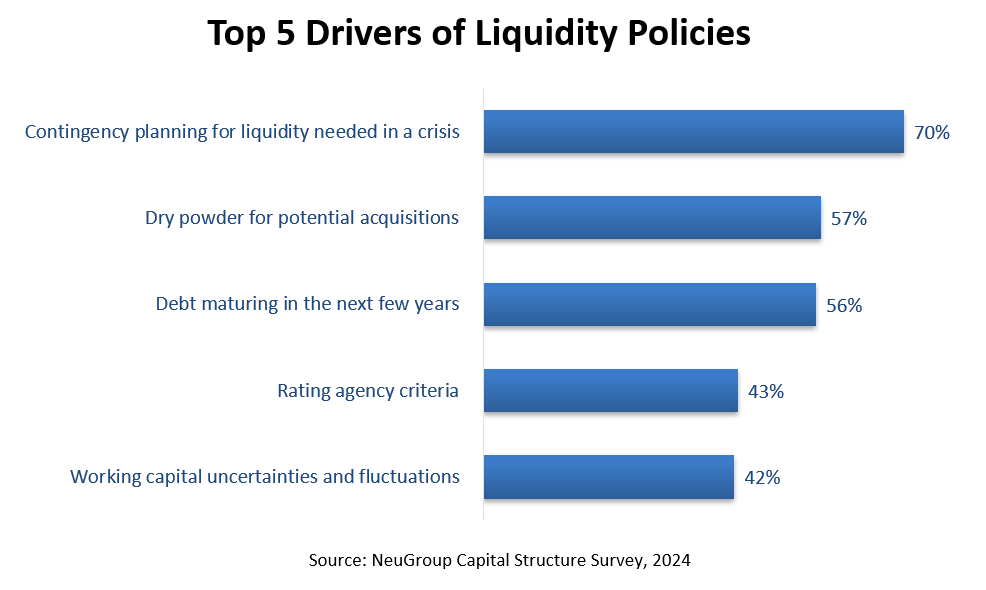
Conducted in partnership with Standard Chartered , the survey yielded benchmarking data on capital structure related to debt, working capital, dividends, buybacks and more. It’s based on responses from about 130 corporates across various sectors, and full results will be available later this summer.
Context and contrasts. The 70% figure makes perfect sense in the wake of widespread fears about counterparty credit risk sparked by the 2023 collapse of Silicon Valley Bank. In a meeting earlier this year, one treasurer put the banking crisis of confidence in context, calling it a “catalyst for treasury organizations to say, ‘This isn’t just a moment in time. Crisis planning is always a priority.'”
- But it’s also fair to wonder why even more respondents didn’t select contingency planning for liquidity needed in a crisis. NeuGroup’s Roger Heine, who helped conduct the survey, said, “It’s gratifying to see that 70% do this kind of planning, but kind of surprising that the remaining 30% do not.”
- Surprising, perhaps, but not inexplicable when you consider the other answers selected and speak to members who are not among the 70%. The survey shows corporates also prioritize rating agency criteria (No. 4), which place a high value on robust liquidity; and the No. 5 answer, preparation for working capital uncertainties, includes planning for the short-term fallout of a crisis.
- Combining the members who chose those two answers but not contingency planning with the members who did choose it adds up to 90% of respondents.
What they say. A treasurer at a tech company who selected No. 4, No. 5 and debt maturing in a few years (No. 3) told NeuGroup Insights he didn’t select No. 1 in part because his company has relatively high margins and cash balances, and cash flows that are less volatile than industries where most cash is tied to working capital.
- “I prepare contingency scenarios that will allow me to widen my access to investment-grade capital markets to minimize refinancing risk and reduce the refinancing cost, which typically goes up in crises,” he said.
- Another treasurer at a high-margin enterprise elaborated on why he didn’t choose contingency planning for a crisis. “The structure of the company results in almost every subsidiary having positive cash flow,” he said. “As a result, I don’t need to focus on the daily liquidity needs of 50-plus subsidiaries. A crisis for us does not happen without notice.”
The dealmakers. The second most common driver of policies is maintaining liquidity for potential acquisitions, at 57%. The context here is pent-up demand for deals and improvement in M&A volume in 2024 after a severe slump last year as interest rates remained high.
- One notable insight from the survey results: corporates with relatively higher price-to-earnings (P/E) ratios are more likely to prioritize a need for dry powder. That’s a sign they expect to leverage their high valuation to pursue growth opportunities through strategic acquisitions.
- For members with a forward P/E ratio over 25, acquisitions are the most common liquidity driver. For members with a PE below 10, it drops to fifth place.
Stay tuned to NeuGroup Peer Research for the full survey report, including more in-depth insights and analysis of members’ capital structures.
Dive in