
Articles
May 2, 2019
Bloomberg Exits KYC and the Market Moves On

# Banking
# Risk Management
Bloomberg Entity Exchange is closing up shop soon, but there are plenty of players out there.
Bloomberg confirmed in early April that it plans to shut down Entity Exchange, a know-your-customer (KYC) solution that was supported by Citibank and adopted by multinational corporations including Coca-Cola.
Industry insiders say an internal management change led to a review of Bloomberg’s product portfolio, with Entity Exchange and the company’s sell-side execution and order management solutions businesses getting cut. Bloomberg, they say, was looking to focus on its core offerings. A Bloomberg spokesperson would only say that “the company’s intention is to exit its KYC business.”
But a look at the current state of the AML/KYC sector (AML being anti-money laundering) shows that at least for KYC, Bloomberg was up against stiff competition and facing an uphill battle just to get into the market. Large, established players, lots of new technologies being adopted, and looming industry disruptors likely forced Bloomberg to conclude it was better to put the resources toward more profitable business lines.
REFINITIV LEADS
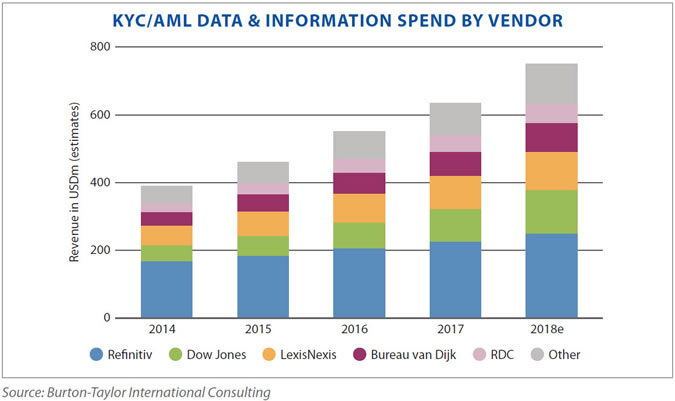
The current size of the AML/KYC market is about $750 million and growing, according Burton-Taylor, an international consulting firm. The market includes not just AML/KYC, but also services relating to financial crime and compliance activities. And it is “a major area for budget increases,” with estimated global spending projected to grow 18.3% in 2018, Burton-Taylor says, generating an estimated five-year compound annual growth rate of 17.5%.
Refinitiv’s AML/KYC solution, formerly a Thomson Reuters product, leads the industry with over a quarter market share, with Dow Jones, LexisNexis, Moody’s Analytics’ Bureau Van Dijk, Regulatory DataCorp and a handful of smaller players making up a large part of the rest of the market. Burton-Taylor says it considers Refinitiv “to be the largest provider of AML/KYC data and information in the world.”
Meanwhile, Bloomberg’s planned departure has intensified competition among other companies scrambling for market share.
Burton-Taylor reports that “M&A activity and in-house development” have had a big impact on the market in the last decade as providers look to “meet existing and new client needs with advanced technology and granular data.” This has meant a “new wave of technology-savvy market entrants is coming forward to supplement, and challenge, the offerings of more established, data-centric suppliers.”
Bloomberg was part of the smaller group of tech-savvy entrants, which includes info4c, Acuris Risk Intelligence, Arachnys, Opus, ComplyAdvantage, NominoData, and Kompli-Global. Also, SWIFT, the international payments network, said recently that beginning in Q4 2019, all 2,000 SWIFT-connected corporates will be able to join its KYC Registry and use it “to upload, maintain and share their KYC information with their banks.” All of these companies, both established and newcomers, bring different expertise to different areas of AML/KYC.
The established players have vast searchable databases while the newcomers offer innovative technology.
BLOCKCHAIN
Among the players hoping to gain momentum from Bloomberg’s departure are companies touting the benefits of solutions that don’t depend on a centralized “utility,” or third party that stands between a bank and a corporate client. Blockchain is the answer to solving the problem, they argue. “I strongly believe this is the moment for decentralized KYC solutions,” says Gene Vayngrib, CEO of Tradle, which has developed a blockchain-based KYC solution. “In addition to not having a central store, Tradle leaves the data in the hands of the rightful owners, the treasurers,” he said.
Another company that is trying to gain a foothold, Aptiv.IO, is using blockchain to create what it calls company “trust vaults that allow companies to distribute their private information on their terms.”
With a trust vault, “You decide how you want to communicate with the outside world,” says CEO Guy Mounier. “It’s ‘privacy by design’ and uses zero trust architecture,” he says. Zero trust architecture works by employing a network-centric data security strategy, which in turn provides specific access only to those who need it. So if a company is giving out sensitive information through blockchain, it can better control who has access to that data.
Although blockchain can be considered a disruptor of the current model of centralized data, “This is not replacing anything,” Mr. Mounier says. “It can fit into what you have and you can map out where the data goes. It’s data enrichment as a data service.” He adds that data can be auto-refreshed as people, data or situations change.
NOT JUST KNOWING YOUR CUSTOMER
While they are known as AML/KYC providers, it goes beyond that. Many companies also offer continuous monitoring of the web, the dark web and other so-called “darknets” like The Onion Routing project, Tor or Invisible Internet Project, for any negative news or mentions of a company or the sale of IP or customer data.
“Companies don’t just want these static databases that just sit there,” says Jennifer Milton, an analyst at Burton-Taylor and author of the firm’s research on AML/KYC. “They want dynamic databases that can constantly search the web and the dark web.” She adds that machine learning is helping shape this kind of technology, where context can help detect references to companies even if the names are spelled incorrectly or hidden in some way.
THE LEGACY OF ENTITY EXCHANGE?
The end of Bloomberg Entity Exchange doesn’t mean the end of the influence it may have on the market. Several competitors say the company helped shine a light on KYC’s importance. Prior to the last couple of years, companies were reluctant to invest significantly in a cost center like compliance. “But now they are forced to spend,” says Jennifer Milton, an analyst at Burton-Taylor. “Who are you dealing with and how do you know them are important questions that companies can run into trouble with if they don’t have the answers; if there’s not an audit trail of transactions.”
Dive in
Related
Insights
Russia Sanctions and Exits: Devil’s in the Details
By Paul Dalle Molle • Mar 24th, 2022 • Views 37
Insights
The Sun Sets for Some on Easy, Shared Access to Bloomberg Terminals
Sep 23rd, 2021 • Views 79
Insights
Russia Sanctions and Exits: Devil’s in the Details
By Paul Dalle Molle • Mar 24th, 2022 • Views 37
Insights
The Sun Sets for Some on Easy, Shared Access to Bloomberg Terminals
Sep 23rd, 2021 • Views 79