
Articles
February 12, 2026
Treasury’s AI Push Runs Into a Familiar Problem: Data Quality

# Technology
NeuGroup’s 2026 Outlook Survey finds treasury teams are leaning into AI but obstacles are slowing progress.
As treasury teams push toward AI adoption, the real challenge is shifting from innovation to reliability, according to NeuGroup’s 2026 Outlook Survey. The full survey, which will be available for download soon on NeuGroup Peer Research, shows that AI now ranks as treasury’s No. 2 objective for 2026, behind only cash forecasting—but concerns around data quality are the biggest factor influencing how quickly tools can scale.
- In 2026, 60% of treasury teams describe an AI approach that goes beyond the earliest stages, whether through a hybrid model, third-party tools or in-house development. By comparison, NeuGroup’s 2025 Outlook Survey found that only 33% of teams were using or piloting AI a year ago.
- That growing focus on AI helps explain why data is one of treasury’s most pressing issues heading into 2026. In a question on overall obstacles to achieving treasury objectives, 57% of respondents cited a lack of access to a single, consistent source of data, making it the second-most common obstacle overall—an issue that also ranks as members’ top concern around implementing AI tools (see chart below).
- The results underscore a key point treasury leaders have been discussing for years: AI may accelerate automation and decision support, but only if the underlying data is accurate, consistent and reliable.
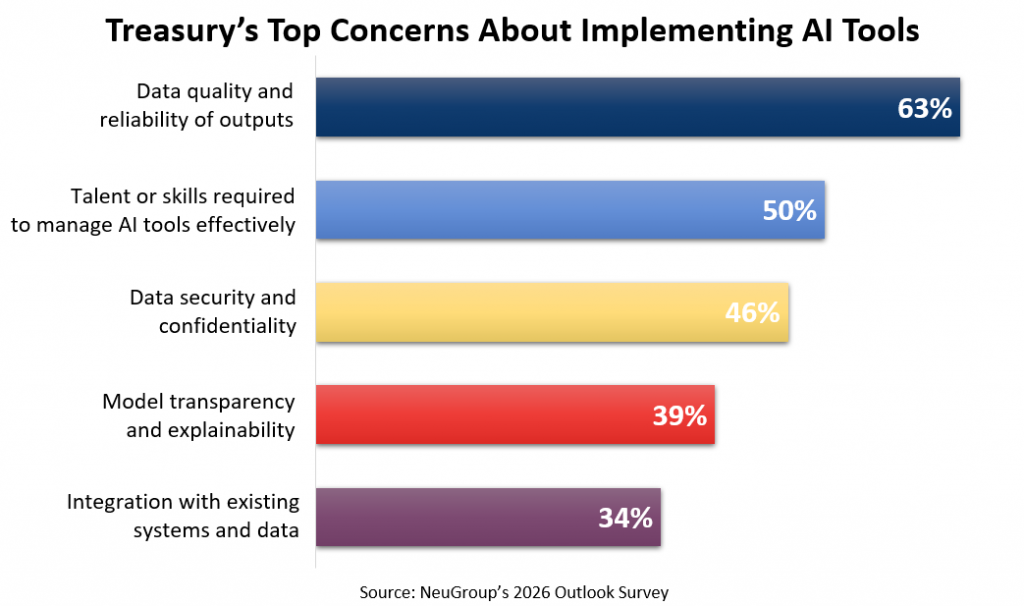
Primary obstacles to AI adoption. As treasury teams move from experimentation toward implementation, concerns are shifting from what AI tools can do to whether their outputs can be trusted. As noted, data quality and reliability emerged as the most frequently cited concern around implementing AI tools—ahead of other issues including data security and model transparency.
- Recent NeuGroup sessions have consistently highlighted timing gaps, inconsistent reporting and fragmented data as ongoing issues as treasury teams begin applying AI tools.
- Talent also remains a key consideration. Half of respondents pointed to the skills required to manage AI tools effectively, reinforcing that data governance and oversight remain as critical as the technology itself.
- Integration with existing systems surfaced as another important factor. One-third of respondents cited integration with existing systems and data as a concern, underscoring the complexity of deploying AI across ERP, TMS and bank reporting environments.
Implementation takes multiple forms. Rather than relying exclusively on vendors or building everything internally, many treasury teams are combining approaches as they move from exploration toward implementation.
- About three-quarters of respondents are implementing or exploring generative AI, about one-half are doing the same with machine learning-based predictive models and about one-third are using or experimenting with agentic AI.
- Among teams already moving into implementation, nearly one-third of respondents report pursuing a hybrid model that combines third-party tools with internal capabilities.
- Reported impact to date is concentrated in workflow automation and productivity improvements, with fewer respondents pointing to gains in core treasury outcomes like forecasting accuracy.
Stay tuned to NeuGroup Peer Research to download the full report, coming soon, featuring additional findings on AI adoption, cash forecasting priorities and other obstacles treasury teams expect to face in 2026.
Popular
Dive in