
Articles
February 6, 2025
The Impact of Tariffs: NeuGroup’s 2025 Treasury Outlook Survey

# Foreign Exchange
# Tax
The effects of tariffs and changes in immigration policy on inflation, the economy and rates top the list of impacts.
President Trump’s announcement last Saturday of 25% tariffs on imports from Mexico and Canada seemed to confirm the expectations of the vast majority (87%) of respondents to NeuGroup’s 2025 Treasury Outlook Survey who said tariffs would have the greatest impact on them of any changes under the new administration (see chart).
- “When he announced them over the weekend, it’s like everyone’s hair was on fire, and yet, we’ve been talking about this for months,” one treasurer at a mega-cap multinational told NeuGroup Insights.
- On Monday, Mr. Trump put the tariffs on Mexico and Canada on hold for 30 days. A 10% additional tariff on Chinese imports remains—at least for now (China retaliated).
- “The whole thing just leads to an incredible amount of uncertainty and unpredictability,” the treasurer said. While most corporates will wait before making major changes to supply chains, he added, “companies like ours are going to take whatever steps we need to take to get ready to ask for exemptions of certain goods.”
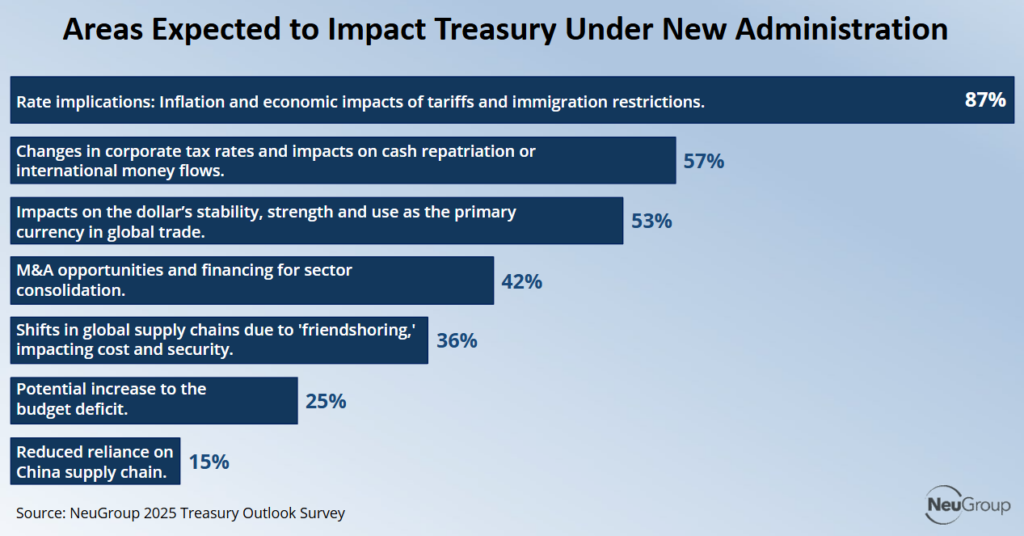
The risk factor. The challenges posed by tariffs are likely a key reason respondents to the NeuGroup Outlook Survey ranked political, legislative and regulatory risks first among the top five risks they face in the year ahead. Several respondents mentioned tariffs in the comments section of that question, noted Joseph Bertran, Senior Director of Research at NeuGroup, who conducted the survey.
- “The responses to these two questions clearly validate NeuGroup members’ concerns about tariffs, as they’ve shared anecdotally and in other surveys,” Mr. Bertran said. “Tariffs are clearly top of mind for treasury teams that manage FX and interest rate risk and must forecast cash flow and manage liquidity.”
- As the chart shows, respondents ranked the effects of corporate tax rate changes on cash repatriation or international money flows second, selected by 57% of respondents—30 percentage points behind tariffs and immigration. Members were asked to select up to five areas that will drive the most change.
Knock-on effects. Asked how tariffs may affect treasury, another treasurer of a mega-cap multinational said, “The knock-on effects for FX, rates, equities and the resulting volatility are something that all treasurers will have to deal with.” He added, “Beyond that, this is something that will impact so many areas across a company’s business and treasurers will need to understand the impacts on cash flows, investment, pricing.”
- The broad implications of potential tariffs prompted the first treasurer’s company to form a multifunctional team including tax, treasury, supply teams, legal, government relations and representatives of the business units. But the sudden, surprising timing of the tariffs presented some challenges.
- “Everybody’s a stakeholder in this thing and I will admit it’s been a little bumpy trying to coordinate ourselves and figure out who’s got the lead on things and even identifying what are those things that we need someone to take a lead on,” the treasurer said.
Supply chain focus. That said, the goal is clear: “What we’re trying to do is identify and be able to pinpoint the supply chains to be able to ensure we know where there’s potential risks,” he explained. “That gets difficult because we have a lot of third-party suppliers in the U.S. who themselves are sourcing goods from, for example, Mexico.
- “If we’re buying from a third-party supplier, we may not know where they’re getting their stuff. Presumably, their cost or cost of tariffs will get passed on to us.”
- A related concern: “Right now, the Mexican tariffs are off. But what if you’re buying from a Mexican supplier who themselves had purchased from a Chinese company? Do the China tariffs apply or not? So there’s those sorts of scenarios.”
FX exposures. Amol Dhargalkar, Global Head of Corporates at Chatham Financial, said supply chains—not FX exposures—are the right place for corporates to start assessing risk. “Before considering FX risk, the larger considerations for organizations are impacts on their supply chains in both the short and long term,” he said.
- “Ultimately, discussion and implementation of tariffs has an impact on the dollar,” he noted. “Expectations of the dollar strengthening require organizations to review their FX programs for effectiveness. We’ve seen quite a few large companies reviewing their programs in 2024 and early 2025 in preparation for this moment.”
- Mr. Dhargalkar summed up a sentiment echoed by treasurers and others waiting for new developments and announcements on U.S. trade policy: “It’s still unclear if tariffs are here to stay or just a negotiating tool.”
Popular
Dive in