
Articles
June 17, 2026
Kyriba Tops FIS, ION and SAP in TMS Use by NeuGroup Members

# Treasury Management System (TMS)
# Technology
NeuGroup Peer Research benchmarking data shows average TMS satisfaction at 3.6 out of 5, with 11% dissatisfied or very dissatisfied.
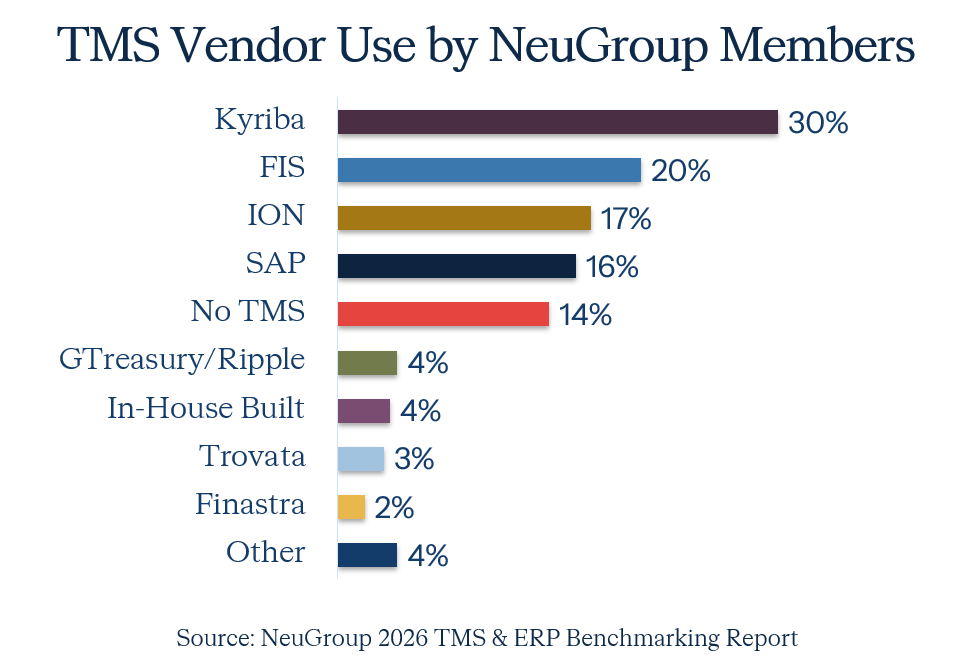
Kyriba is the treasury management system used by the largest percentage of members surveyed for the NeuGroup 2026 TMS & ERP Benchmarking Report released this week. As the chart below shows, nearly one-third (30%) of 226 respondents use Kyriba’s cloud-native platform, followed by 20% for FIS (Quantum and Integrity) and 17% for ION, whose six brands include Reval and Wallstreet Suite. About 16% of members use treasury modules offered by SAP, which dominates ERP usage, with two-thirds of 215 respondents using either SAP ERP or SAP S/4HANA. Revenue is a strong predictor of TMS choice: Kyriba is well established in the mid-market ($5 billion to $20 billion), while FIS Quantum and SAP treasury modules dominate at companies with the highest revenues. You can find the full report by clicking here.
Satisfaction scores, AI impact. While the perceived shortcomings of TMSs are a frequent topic of conversation at NeuGroup meetings and sessions, members on average ranked their level of satisfaction at 3.6 out of 5, with Kyriba’s average at 3.9, FIS at 3.6, SAP at 3.4 and ION at 3.3. Despite the relatively high overall average score, 11% of respondents said they are dissatisfied or very dissatisfied with their existing TMS. And among 43 members who shared customer service ratings, the average score was just 3.1, with FIS at 3.5, SAP at 3.1, Kyriba at 2.9 and ION at 2.8.
- Those satisfaction and customer service scores provide context for the report’s finding that 14% of respondents are considering changing their TMS provider, while 76% do not plan to make a change. The big question now is how advances in AI will affect the decision of corporates to stay with their current vendor or seek solutions outside of TMS platforms.
- “AI features are increasingly being embedded into TMS software, but it is also becoming more common for companies to forgo a full TMS suite in favor of stand-alone AI solutions,” said Joseph Bertran, head of NeuGroup Research and author of the report. “The main sentiment is that AI is becoming a layer above fragmented treasury infrastructure, and it may replace portions of the treasury workflow well before it replaces the TMS itself.”
Dive in
Related
Article
ICD Guides NeuGroup Members Assessing Risks and Rewards in Money Markets
Sep 17th, 2020 • Views 7
Article
ICD Guides NeuGroup Members Assessing Risks and Rewards in Money Markets
Sep 17th, 2020 • Views 7