
Articles
July 24, 2024
A Journey to Strategic Treasury Starting With the Right TMS

# Treasury Management System (TMS)
# Technology
EY says aligning a TMS with a technology strategy is key to transforming treasury into a strategic force.
Elevating treasury’s profile to a strategic function is essential for organizations seeking to enhance financial agility and resilience. The preeminence of this priority permeated NeuGroup’s 2024 Treasurers Summit, where treasurers from companies of various sizes from diverse sectors expressed commitments to making treasury a strategic business partner. However, an in-session poll revealed that few believe they have fully achieved this goal.
- In a presentation by EY, the Summit sponsor, the firm’s managing director of global treasury services Ari Morris and senior manager of global treasury advisory Martha Grant emphasized that aligning a treasury management system (TMS) with an overall tech strategy is crucial for transforming treasury into a strategic player.
- “The importance of the journey of treasury technology is that it’s never-ending,” Ms. Grant said. “Just like your journey within the organization will always change, so does the technology.” By linking the TMS with the broader technology strategy, she said organizations can better support their strategic goals and create significant value in the long run.
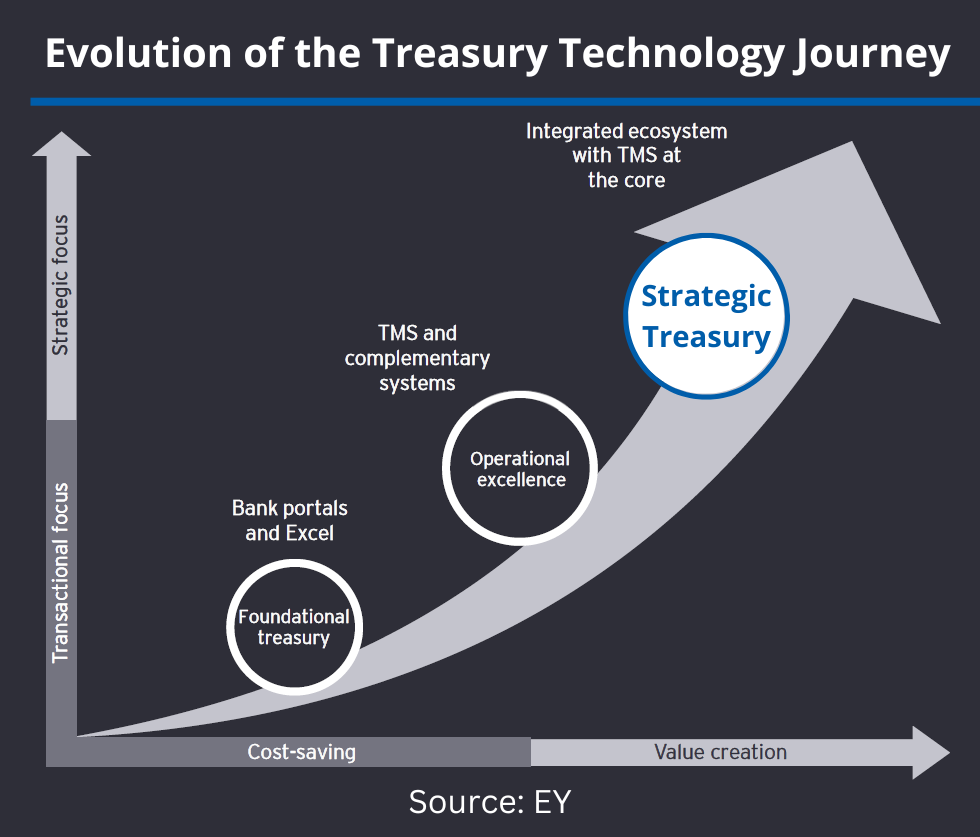
Stages of the treasury technology journey. Mr. Morris and Ms. Grant laid out what they consider the stages of a treasury technology journey—from foundational treasury with bank portals and Excel, to operational excellence with a TMS and complementary systems and finally to strategic treasury, featuring what they call an “integrated ecosystem” built around a TMS (see chart above).
- The in-session poll also showed that most members consider their treasury to be in the second stage—operational excellence—with a handful placing themselves in the foundational stage, and few saying they’ve completed the journey to being a partner to the business.
- The EY experts stressed that understanding and navigating these stages is key to transforming treasury into a strategic function that can support the company’s growth initiatives, inform business decisions beyond treasury and optimize global liquidity.
- Companies often start with basic transaction management and eventually graduate to more robust TMS solutions; the ultimate goal, they said, should be moving beyond day-to-day operations and leveraging the TMS for strategic insights. “Organizations that have achieved this transition are ahead of the curve, but delivering strategic value is challenging and requires a solid foundation,” Mr. Morris said.
Start by identifying specific needs. He emphasized that the success of a TMS hinges on ensuring the system meets the specific needs of the organization. “If you don’t tune your tools to your needs, it won’t be successful.”
- He highlighted the importance of starting a treasury transformation with a thorough self-assessment. This involves evaluating current operations, identifying areas for improvement, and defining strategic goals. “Whether you’re minimizing cost, becoming more efficient, or optimizing your balance sheet, understanding your starting point is crucial,” he said.
- A lack of preparation when vetting options for a TMS caught up with one member once they started implementing the platform. By the time the treasurer realized the solution wouldn’t live up to treasury’s strategic goals, “my team was already some percentage into the project and had spent years working on it. It was hard for me to kill it, so I learned to live with it.
- “It’s not my favorite, but it’s enough. We’re not strategic because of the tool, but we’re still able to be strategic despite the tool.”
Continuous improvement and adaptation. Ms. Grant highlighted the importance of viewing the implementation of a TMS as an ongoing process rather than a one-time project. In the never-ending treasury tech journey, she said, “effective data management and strategic decision-making require ongoing adjustments and collaboration with stakeholders.”
- One key aspect of a successful TMS implementation is integration with other systems and ensuring a robust data strategy—which involves collaborating with internal IT, FP&A and other stakeholders to bring treasury out of its traditional silo.
- The ultimate goal of achieving a strategic treasury, Mr. Morris noted, requires enhancing data capabilities and analytics—some of which can be done in the TMS, if the right system is chosen. While members agree with that ideal, some said that TMS limitations can get in the way.
- “If you ask many companies that implemented a TMS, their objective was a single, core system,” said one member. “What you find most times is, as you build out a TMS, cash management works well, but forecasting, hedge accounting, etc., have hiccups. So they revert to what they know, like Bloomberg.”
- He added this would leave a team in the operational excellence stage of treasury growth. “You might end up with a core TMS, and various systems that do things for you. Maybe it’s due to implementation, or maybe due to the ineffectiveness of the tool.”
- Mr. Morris said companies that find themselves in this position don’t necessarily need to abandon their TMS, recommending careful consideration for which additional solutions fit. “Don’t grab tools for their own sake, but plan out where they make sense, identify what you’ve got, what’s not ideal, and solve that problem.”
Dive in
Related
Article
Reimagining the Regional Treasury Center’s Strategic Role
By Joseph Neu • Mar 9th, 2023 • Views 32
Article
Reimagining the Regional Treasury Center’s Strategic Role
By Joseph Neu • Mar 9th, 2023 • Views 32